In semiconductor packaging and high-end precision instrumentation, wire diameters are frequently required to range from 10μm to 50μm. Traditional tungsten carbide or polycrystalline diamond (PCD) dies struggle to achieve nanoscale surface roughness due to the presence of grain boundaries. The core advantage of SSCD dies in micro-wire applications lies in their highly consistent single-crystal structure. This enables the die’s inner bore to be polished to a mirror finish, completely eliminating surface damage during the high-speed drawing of ultra-fine wires.
SSCD Technical Analysis: The Industry Standard for sscd-wire-drawing dies-micro-wire applications
In the micro-wire drawing process, a die is not just a forming tool; it is a critical point of thermodynamic equilibrium. SSCD dies “Synthetic Single Crystal Diamond” (often abbreviated in the industry as SSCD or SSD), with their exceptionally high thermal conductivity and ultra-low friction coefficient, effectively suppress work hardening while significantly reducing drawing force.
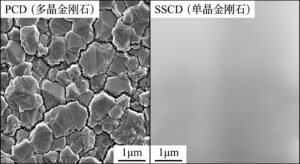
1. Eliminating Surface Scratches (Surface Finish Optimization)
Semiconductor bonding wires (such as high-purity gold, silver, or palladium-coated copper wire) have zero tolerance for surface defects. Because SSCD dies lack grain boundaries, they prevent the microscopic accumulation of metal debris on the die surface during drawing. This mirror-grade bore quality ensures a highly pristine wire surface, drastically reducing skin effect losses in high-frequency signal transmission.
2. Extreme Wire Diameter Consistency Control
For ultra-fine wires spanning tens of thousands of meters per spool, even minor fluctuations in wire diameter can cause immediate downtime in downstream automated packaging equipment. The isotropic hardness of SSCD ensures that the die’s bearing area remains dimensionally stable over hundreds of kilometers of drawing mileage. By precisely controlling the reduction angle and bearing length, SSCD dies maintain continuous wire diameter tolerances within a strict ±0.5μm range.
Semiconductor Wires: The Guardian of Ultimate Finish and Conductivity
The semiconductor industry demands wires that are not only “fine” but also “pure” and “smooth.” SSCD dies perform exceptionally well when drawing copper bonding wire. Their chemical inertness effectively prevents affinity reactions between copper atoms and the die surface, thereby preserving the wire’s structural integrity, high electrical conductivity, and oxidation resistance.
Fine Alloy Wires: Overcoming Drawing Challenges of High-Hardness and Special Materials
For high-strength alloys used in the medical and aerospace sectors, SSCD dies provide a process window unmatched by traditional materials.
1. Precision Forming of Medical-Grade Alloy Wires
When manufacturing Nitinol for cardiac stents or stainless steel microwires for surgical sutures, the material’s work-hardening rate is extremely high. By reducing frictional heat generation, SSCD dies delay the work-hardening process. This allows the wire to maintain high tensile strength while retaining excellent elongation, meeting the strict flexibility requirements of medical interventional devices.
2. Overcoming the “Galling” Phenomenon in High-Hardness Materials
Drawing refractory metals like tungsten and molybdenum often leads to wire breakage caused by “galling” (material adhesion to the die wall). The high chemical stability of the SSCD die surface makes it a natural anti-adhesion tool. This anti-galling wire drawing die characteristic not only extends die life but also ensures the physical continuity of the alloy wire’s surface under extreme stress.
| Parameter (Material Characteristics) | SSCD (Synthetic Single Crystal) | PCD (Polycrystalline) | ND (Natural Diamond) |
| Grain Boundaries | Zero (Monocrystalline) | Yes (Binder phase present) | Zero (Monocrystalline) |
| Surface Finish Capability | Nano-scale (Mirror) | Micro-scale | Nano-scale (Mirror) |
| Wear Predictability | Extremely High (Isotropic) | High | Variable (Natural inclusions) |
| Optimal Wire Diameter | 10μm – 50μm+ | > 50μm | 10μm – 50μm+ |
Summary of Core Advantages of SSCD Dies (SSCD vs. Other Materials)
When evaluating Total Cost of Ownership (TCO), SSCD dies are the inevitable choice for factories pursuing ultimate quality and high yield rates:
-
Ultra-Long Lifespan: The wear resistance of SSCD dies is hundreds of times that of tungsten carbide. As a highly reliable synthetic diamond wire drawing die alternative to natural diamond (ND) dies, it eliminates the unpredictability of internal cracks and impurities found in natural diamonds, delivering extremely stable performance output.
-
Reduced Wire Breakage Rate: Through optimized reduction zone geometry design and nanoscale polishing technology, SSCD dies minimize drawing tension fluctuations in ultra-fine wires, drastically reducing breakage frequency.
-
Decreased Downtime: Because the bearing zone wears extremely slowly, production lines do not require frequent stops to adjust equipment or replace dies, significantly boosting the Overall Equipment Effectiveness (OEE) of drawing machines.
Custom Die Geometry Optimization Material rheology dictates die design. We engineer custom SSCD profiles tailored to your specific alloy. Contact our engineering team to calculate the precise reduction angles and bearing lengths required to eliminate your current drawing bottlenecks.